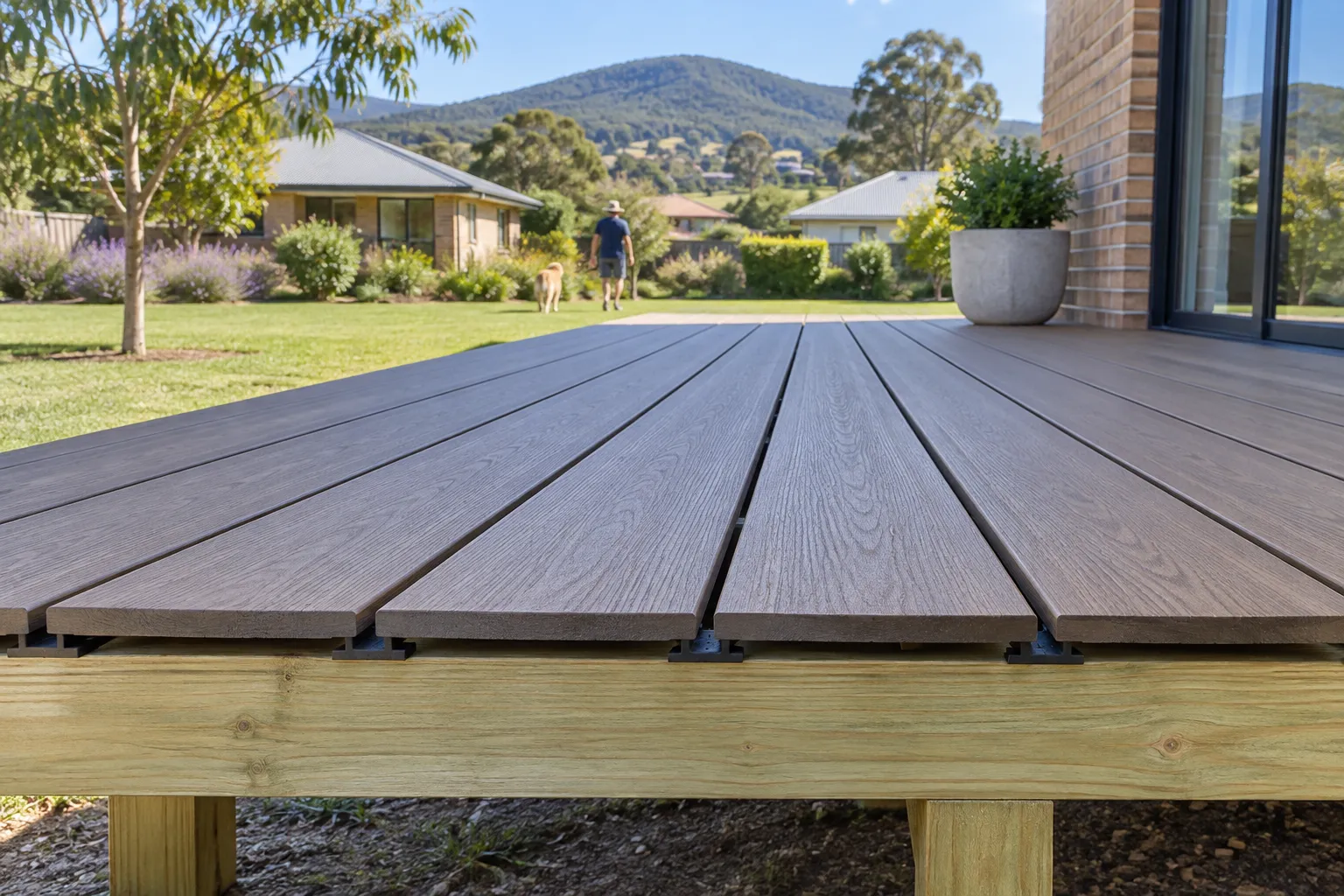
Composite decking is laid on a level frame of joists, usually closer together than for hardwood, and fixed with hidden clips that hold each board while leaving a set gap for drainage and expansion. The ends and edges need small gaps too, and the frame needs airflow underneath. Every brand publishes its own installation guide, and following it keeps the warranty valid. This page walks through the job step by step and helps you decide between doing it yourself and having a builder lay it. For the boards themselves, brands and costs, see our main page on composite decking. If you'd rather have it built, we'll arrange a visit and a local deck builder comes to you with a written quote.
How do you lay composite decking, step by step?
Composite decking goes down in five stages: check approval, build or check the frame, set out the first board square, clip the boards down with the right gaps, then fit the fascia, trims and steps. The frame matters most: it must be flat, at the joist spacing the brand specifies, and ventilated. Boards can't hide a crooked or springy frame.
In more detail:
- Check the rules. In NSW, a deck can be exempt development if it meets every state standard, including a floor no more than 1 metre above ground. In Wodonga and the rest of Victoria, the VBA says most decks need a building permit.
- Build the frame. Treated pine (H3 or H4 depending on clearance) or a steel frame. Joists at the spacing in the brand's guide, often 300 to 450 millimetres. Add extra joists where boards butt end to end.
- Start square. Fix a starter clip or starter strip along the first edge, and check the line is straight and square.
- Clip and gap. Each board slides into the clips on the joists. The clip sets the side gap. Leave the end gaps the guide gives for the board length and temperature on the day.
- Finish. Fascia boards to cover the frame edge, trims for steps, and any balustrade.
What do people get wrong when laying composite decking?
The most common mistakes are joists too far apart, no gap at board ends, too little airflow under the deck, fixing boards with face screws instead of clips, and mixing boards from different batches. Each one can cause sagging, buckling, mould or colour patches, and some void the warranty. Most are avoided by reading the brand's guide before buying anything.
| Mistake | What it causes | The fix |
|---|---|---|
| Joists too wide apart | Bouncy, sagging boards | Follow the brand's span table |
| No end gaps | Boards buckle in summer | Leave expansion gaps |
| Low, closed-in frame | Mould and swelling | Leave open sides or vents |
| Face screws | Cracks, voided warranty | Use the brand's clips |
| Mixed batches | Visible colour bands | Buy all boards at once |
Albury's big swing between summer heat and winter frost makes the expansion gaps more important here than in milder places.
Should you lay composite decking yourself or hire a builder?
If you can build a level, square frame, you can usually lay composite boards: the clipping itself is straightforward. Hire a builder when the deck is raised, on a slope, needs approval or a balustrade, ties into the house, or sits on bush fire prone land. In NSW, paid residential building work over $5,000 must be done by a licensed builder under a written contract.
A quick way to decide:
- Good DIY job. A low, small deck on flat ground, on a frame you can build or one that's already sound.
- Builder job. A deck more than about 600 millimetres high, stairs, a balustrade, sloping ground, a steel frame, BAL requirements, or anything needing a permit.
- Either. Re-boarding an old timber deck with composite, if the frame is in good shape and at the right joist spacing.
What affects the cost of a composite decking installation?
Published Australian price guides put a composite deck at about $280 to $700 a square metre installed, including the frame and labour. The board range sets much of the price, then the frame, height, access and design. Picture frame borders, diagonal boards and wide steps add labour. Doing it yourself saves labour but not boards, clips or the frame.
What moves the price on an installed composite deck:
- Frame type. Steel costs more than treated pine but stays straighter. See steel deck framing.
- Layout. Straight runs are quickest. Diagonal and border details take longer and need more joists.
- Height and stairs. More frame, bracing and balustrades.
- Removing an old deck. Usually extra.
These are guide figures. The builder who visits gives you the real price in writing. See composite decking cost for a breakdown by size.
How do you look after composite decking once it's laid?
Once it's down, composite needs little more than a sweep and a wash a few times a year with warm soapy water and a soft brush. Keep the gaps clear so water drains, and rinse off any leaves before they stain. Fix any loose clips early. Most brands publish care guides, and following them keeps the warranty in force.
Our guide to cleaning composite decking covers mould, grease and stains. For long-term life, see how long a composite deck lasts.
Questions people ask
How long does it take to lay a composite deck?
On a frame that's already built and level, a builder can often clip down 20 to 30 square metres of composite in a day or two. A new deck with frame, footings and boards usually takes three to six working days. Stairs, borders and balustrades add time. DIY takes longer, so allow a couple of weekends.
What should you ask before hiring a composite decking installer?
Ask which brands they install regularly, whether they follow the brand's installation guide so the warranty stays valid, what joist spacing and frame they'll use, how they'll ventilate the deck, and whether it needs approval. Ask for a written quote that names the board range and colour. In NSW, check the builder's licence for work over $5,000.
Do you need to be home while composite decking is installed?
Usually only at the start, to confirm the layout, board direction and colour, and at the end for a walk-through. In between, the builder needs access to the site and power, and somewhere to stack the boards flat and shaded. Composite boards should be stored flat and kept out of direct sun before they're laid.
Can you lay composite decking over an old timber frame?
Sometimes. The old frame must be sound, level, free of rot and at the joist spacing the composite brand requires. Many older timber decks have joists at 450 millimetres, which may be too wide for some composite boards. A builder checks the frame and adds joists or replaces timber where needed.
Can composite decking be laid on concrete?
Not directly on the slab. Composite boards need a sub-frame or a batten system that lifts them off the concrete so water drains and air moves underneath. Low-profile frames and pedestal systems are made for this. Check the brand's guide for the minimum clearance.
More services are listed on Albury deck builder.
Where these facts come from
- NSW Government, checking your contractor is qualified
- NSW Planning Portal, exempt development for balconies, decks and patios
- Victorian Building Authority, landscaping and outdoor structures
- Published installed composite decking prices from four Australian cost guides, checked November 2026
Updated