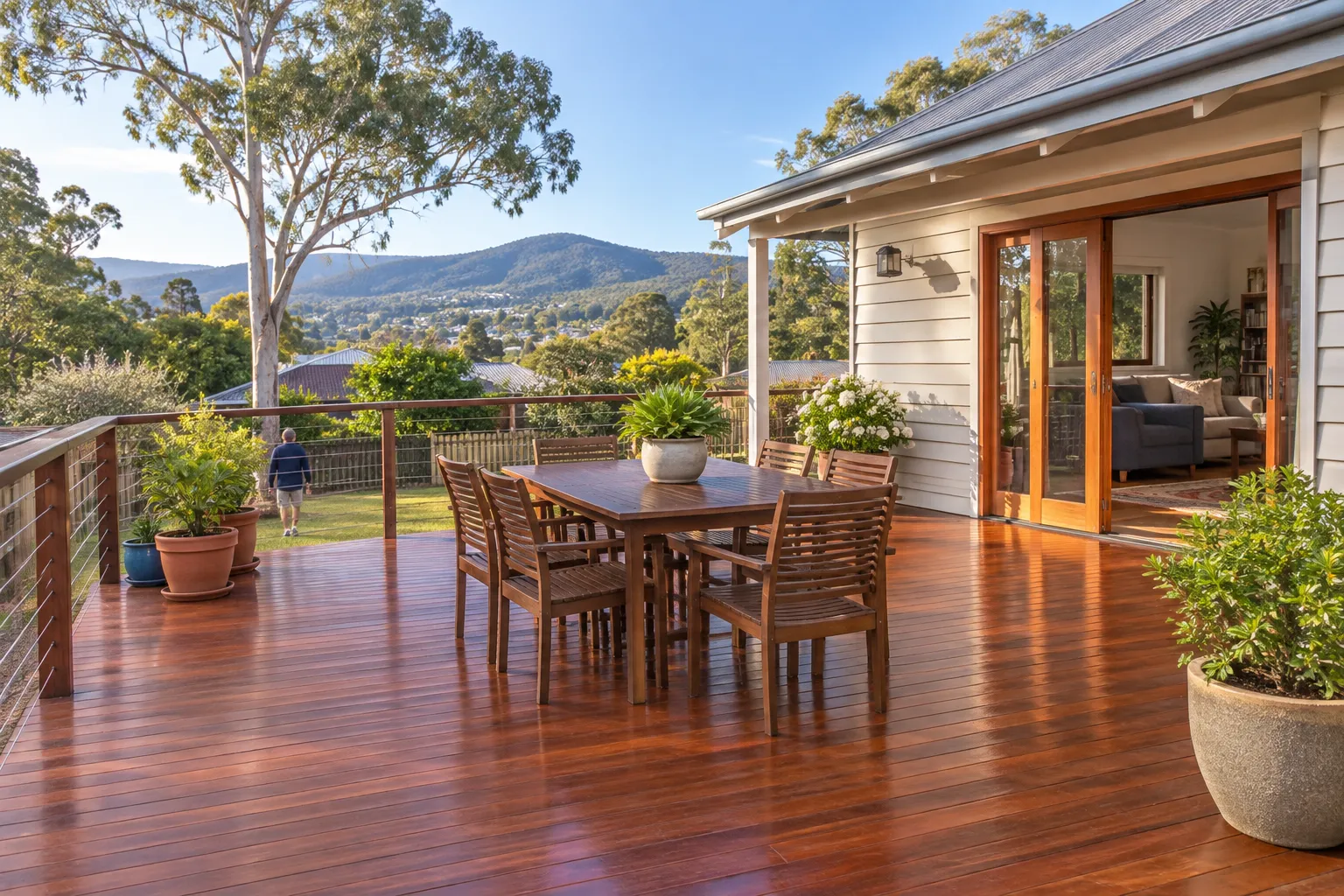
Merbau decking is a dense imported hardwood from South East Asia and the Pacific, prized for its rich red-brown colour and strong natural durability above ground. Around Albury and Wodonga, an installed merbau deck usually costs about $300 to $550 a square metre, depending on height, frame and access. Merbau handles the Border's weather well if it's built and oiled properly, but it bleeds tannin when new and it isn't the right timber for in-ground posts. This page covers sizes, durability, the downsides and what a build involves. If you want a merbau deck built, we'll arrange a visit and a local deck builder comes to you with a written quote.
Is merbau timber treated?
No. Merbau is used untreated because it's naturally durable. The Queensland Government's timber database rates merbau's above-ground durability as class 1, the highest class, with a density of about 830 kilograms per cubic metre. Its in-ground durability is only class 3, so merbau shouldn't be used for posts or stumps in the soil.
What that means for an Albury deck:
- Boards and handrails. Merbau is a strong choice above ground.
- The frame. Bearers and joists are usually H3 treated pine or steel, not merbau. Anything in the ground needs H4 or H5 treated timber, galvanised steel or concrete.
- Termites. Merbau is rated termite resistant, but that's not the same as termite proof. The frame and anything touching the soil matter more. Durability and termite resistance are separate ratings.
What sizes do merbau decking boards come in?
The most common merbau decking sizes in Australia are 140 by 19 millimetres, 90 by 19 millimetres and 70 by 19 millimetres, sold in random lengths, often from about 1.8 to 6 metres. Thicker 140 by 25 millimetre boards are also available for longer joist spans and heavier use. Wider boards cover faster. Narrower boards move less with the weather.
| Board size | Common use | What to know |
|---|---|---|
| 140 x 19 mm | Most decks | Fast to lay, the classic look, moves more across its width |
| 90 x 19 mm | Most decks, steps | Less cupping, more screws and labour |
| 70 x 19 mm | Smaller decks, detail | Most stable, slowest to lay |
| 140 x 25 mm | Wider joist spans, stairs | Stiffer, costs more |
Our pages on merbau decking dimensions, merbau decking 140 x 19 and merbau decking 90 x 19 cover each size in more detail.
How is a merbau deck installed?
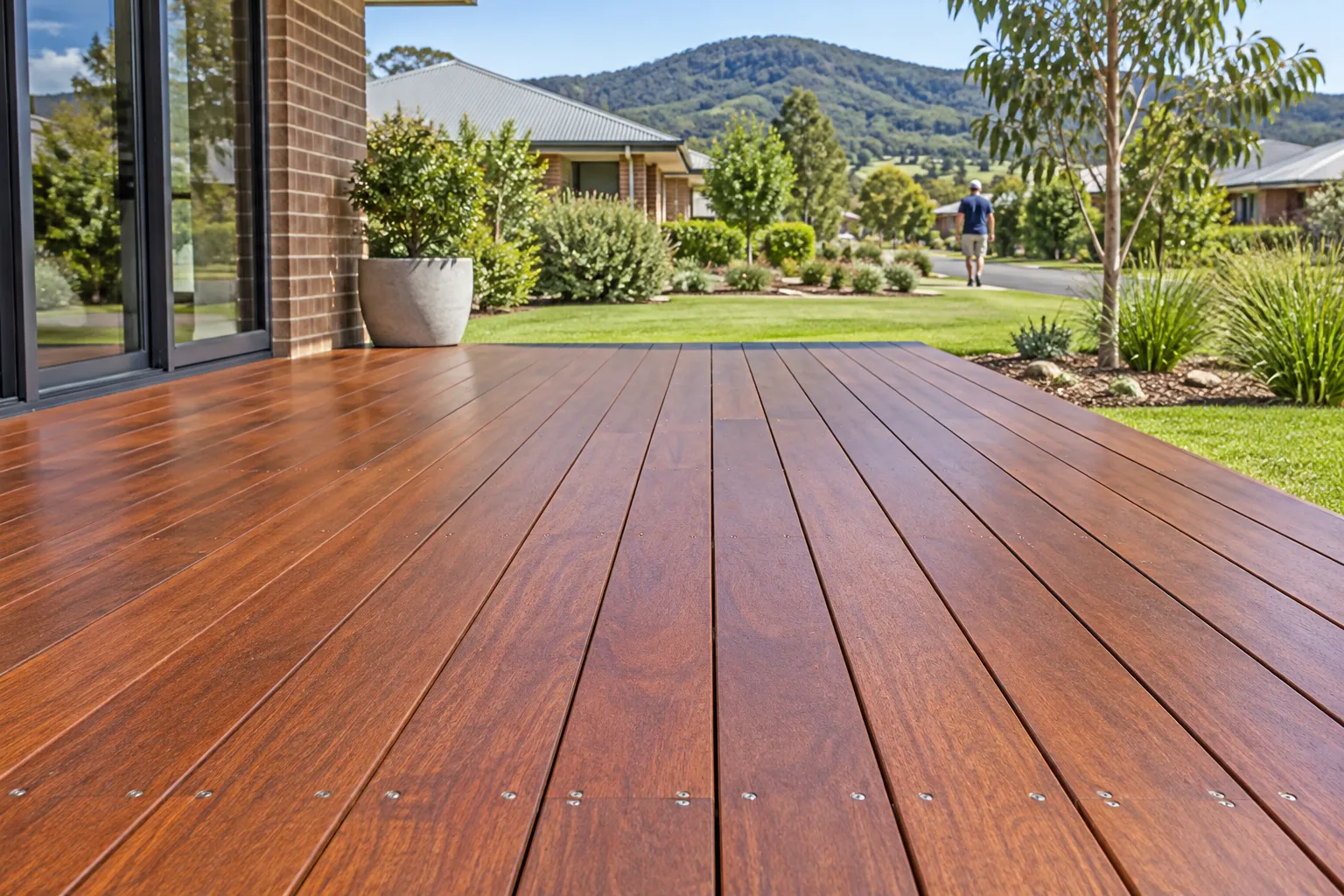
Merbau goes on a level frame of bearers and joists, usually at 450 millimetre joist centres for 19 millimetre boards, with stainless or galvanised screws pre-drilled to stop the ends splitting. Leave a small gap between boards, often 3 to 5 millimetres, so water drains and the timber can swell. Good airflow under the deck stops boards cupping.
The details that make the biggest difference in Albury's climate:
- Spacing. Boards shrink in hot dry summers and swell in wet winters. Gaps that are too tight close up in winter and trap water.
- Fixings. Stainless steel screws avoid black stains around each fixing.
- End sealing. Sealing cut ends slows splitting.
- Ventilation. Low decks over damp ground need open sides or vents.
- Steps and stairs. Stair treads take the heaviest wear and often use 140 by 25 millimetre boards.
What colour is closest to merbau?
Merbau starts out a yellow-brown and darkens to a deep red-brown or chocolate within months of being laid. Most decking oil and stain brands sell a "merbau" tinted shade that matches it, useful for blending new boards with old ones. Without oil, merbau weathers to a silver grey in full sun.
If you're matching a new section of deck to an older one, a tinted merbau oil on both evens out the colour. For broader colour choices, see stain deck colours.
What are the disadvantages of merbau decking?
Merbau's main downsides are tannin bleed, cost and sourcing. New boards leach a red-brown dye when wet that stains concrete, render and pavers. It costs more than treated pine. It can split near the ends if not pre-drilled, and it needs oiling to keep its colour. Because it's imported, check the supplier can show where it was legally harvested.
In more detail:
- Tannin stains. Rinse new merbau often for the first weeks, and protect anything pale below the deck. Most people wait about 6 to 12 weeks before the first oil.
- Upkeep. Merbau needs a clean and re-oil every 12 to 24 months in Albury's sun. See how to clean merbau decking.
- Sourcing. Australia's Illegal Logging Prohibition Act 2012 requires importers to do due diligence on regulated timber. Ask the supplier about the origin and any certification.
- Heat. Like any dark timber, a merbau deck in full afternoon sun gets hot underfoot.
If you're choosing between timbers, read spotted gum vs merbau decking and jarrah vs merbau decking.
What does a merbau deck cost in Albury?
Published Australian price guides put an installed merbau deck at about $300 to $550 a square metre, including the frame and labour. A ground-level 20 square metre deck often lands around $6,000 to $11,000. Raised decks, stairs, balustrades and sloping blocks push it higher. Board prices also change with supply.
What moves the price:
- Height. Decks more than about 600 millimetres off the ground need more frame and usually a balustrade.
- Board size. 90 millimetre boards take more labour than 140.
- Frame. Steel frames cost more than treated pine but don't rot.
- Removing an old deck. Usually extra.
These are guide figures. The builder who visits gives you the real price in writing. See merbau decking cost for more detail.
Questions people ask
How long does it take to build a merbau deck?
A straightforward ground-level merbau deck of about 20 square metres usually takes a builder three to five working days once materials are on site. Raised decks, stairs, balustrades and approvals add time. Wet weather slows footings and concrete. The builder gives you a timeframe with the written quote, so you can plan around it.
How long does a merbau deck last?
A well-built merbau deck with a good frame, airflow and regular oiling can last 20 years or more above ground, based on its class 1 above-ground durability rating. The frame and fixings often fail before the boards do. See how long merbau decking lasts for what shortens and extends its life.
What should you ask before hiring someone to build a merbau deck?
Ask what the frame is made of and how it's protected, what fixings they use, what board size and gap they'll lay, how they'll handle tannin run-off, and whether the job needs council approval. In NSW, residential building work over $5,000 must be done by a licensed builder under a written contract, so ask to see the licence.
Do you need to be home while a merbau deck is built?
Usually not the whole time. Most builders want you there at the start to confirm the layout, levels and access, and at the end to walk through the finished deck. In between, they need access to the site, power and somewhere to stack timber. Agree on access, start times and clean-up before work begins.
Is merbau a good choice for a pool deck?
Merbau is used around pools, but its tannin can stain pool surrounds and coping, and dark boards get hot in summer. Many pool owners choose a paler hardwood or a light composite instead. If you want merbau by the pool, rinse it well before the pool is filled. See pool decks for the options.
In this section
- How long merbau lasts
How long merbau decking lasts in Albury. Its class 1 above-ground durability, why it shouldn't go in the ground, frames and fixings,…
- Cleaning merbau decking
How to clean merbau decking: routine washing, removing tannin stains from paving, reviving grey boards, mould, and preparing merbau for…
- Jarrah vs merbau decking
Jarrah vs merbau decking compared for Albury and Wodonga homes.
- Merbau 140 x 19 boards
Merbau decking 140 x 19 mm: joist spacing, how many metres per square metre, gaps, fixings, cupping on wide boards, and when 90 mm boards…
- Merbau 90 x 19 boards
Merbau decking 90 x 19 mm: coverage per square metre, joist spacing, why narrow boards cup less on low decks, the look, labour and cost…
- Merbau deck cost
What a merbau deck costs in Albury and Wodonga in 2026.
- Merbau decking dimensions
Merbau decking dimensions: common widths and thicknesses, lengths, actual vs nominal sizes, colour changes over time, and deck layout ideas.
- Spotted gum vs merbau
Spotted gum vs merbau decking compared for Albury homes: durability, hardness, colour, tannin, bushfire rating, cost and upkeep, plus…
Every service and price guide is on Border Outdoor Living deck builder.
Where these facts come from
- Queensland Government timber database, merbau fact sheet
- WoodSolutions, natural durability ratings
- Department of Agriculture, illegal logging due diligence for importers
- Published installed decking prices from three Australian cost guides, checked November 2026
Updated