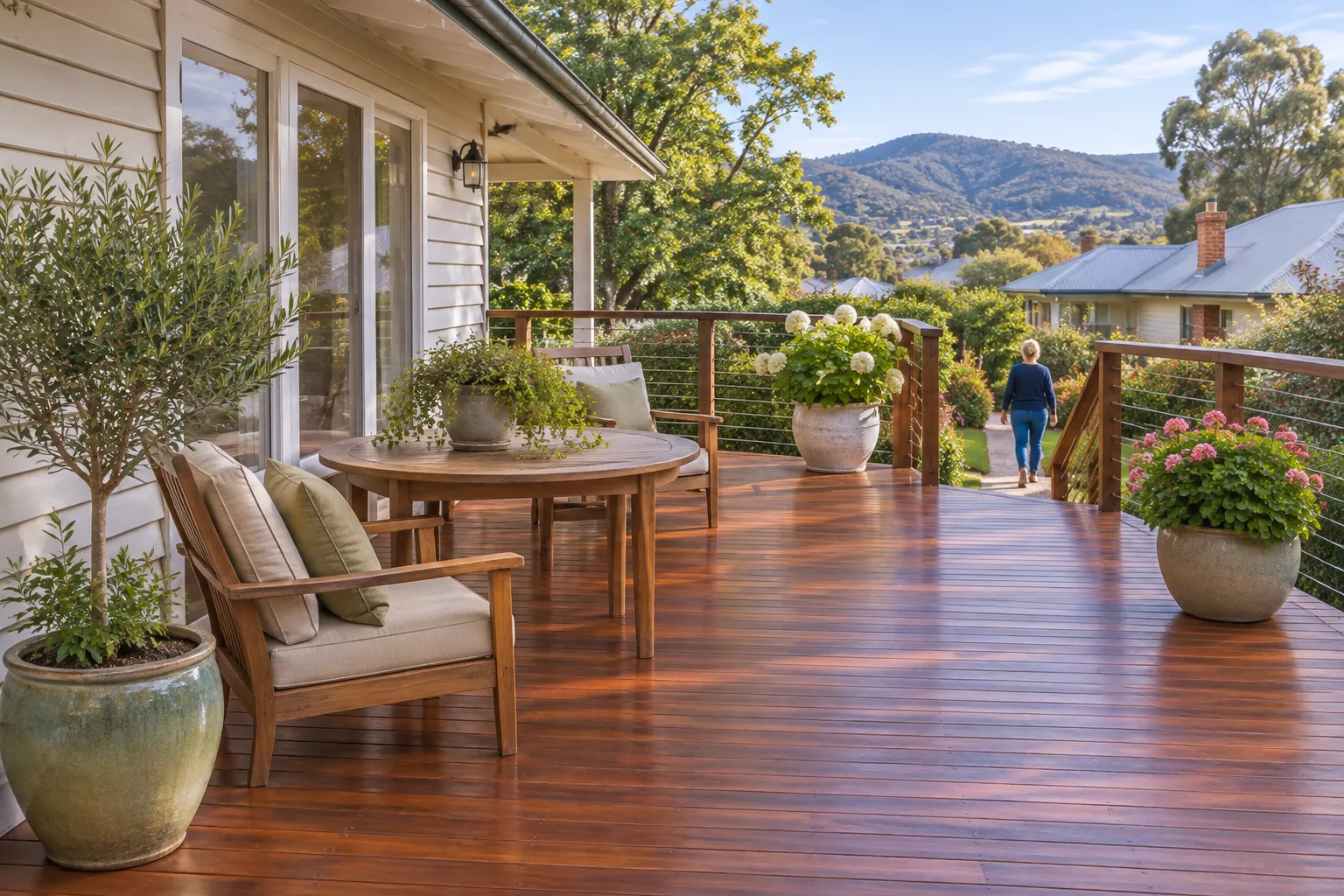
Merbau decking 140 by 19 millimetres is the most common merbau board in Australia: a nominal 140 millimetres wide and 19 thick, usually laid on joists at 450 millimetre centres with a gap of a few millimetres between boards. You'll need roughly 6.9 lineal metres per square metre with a 5 millimetre gap, plus about 10% for waste. It lays quickly and gives the classic merbau look, but wide boards move more with the weather, so gaps and airflow matter. For merbau in general, see our main merbau decking page.
How far does 140 x 19 merbau span?
19 millimetre merbau boards are usually laid on joists at 450 millimetre centres. That's the common spacing for 19 millimetre hardwood decking. Diagonal layouts need joists closer together, because each board spans further between supports. If you want wider joist spacing, thicker 140 by 25 millimetre boards are the usual answer.
| Layout | Usual joist spacing for 19 mm merbau |
|---|---|
| Boards at 90 degrees to joists | 450 mm centres |
| Diagonal boards | Closer, set by the builder |
| Wider spacing needed | Use 25 mm boards |
How much 140 x 19 merbau do you need?
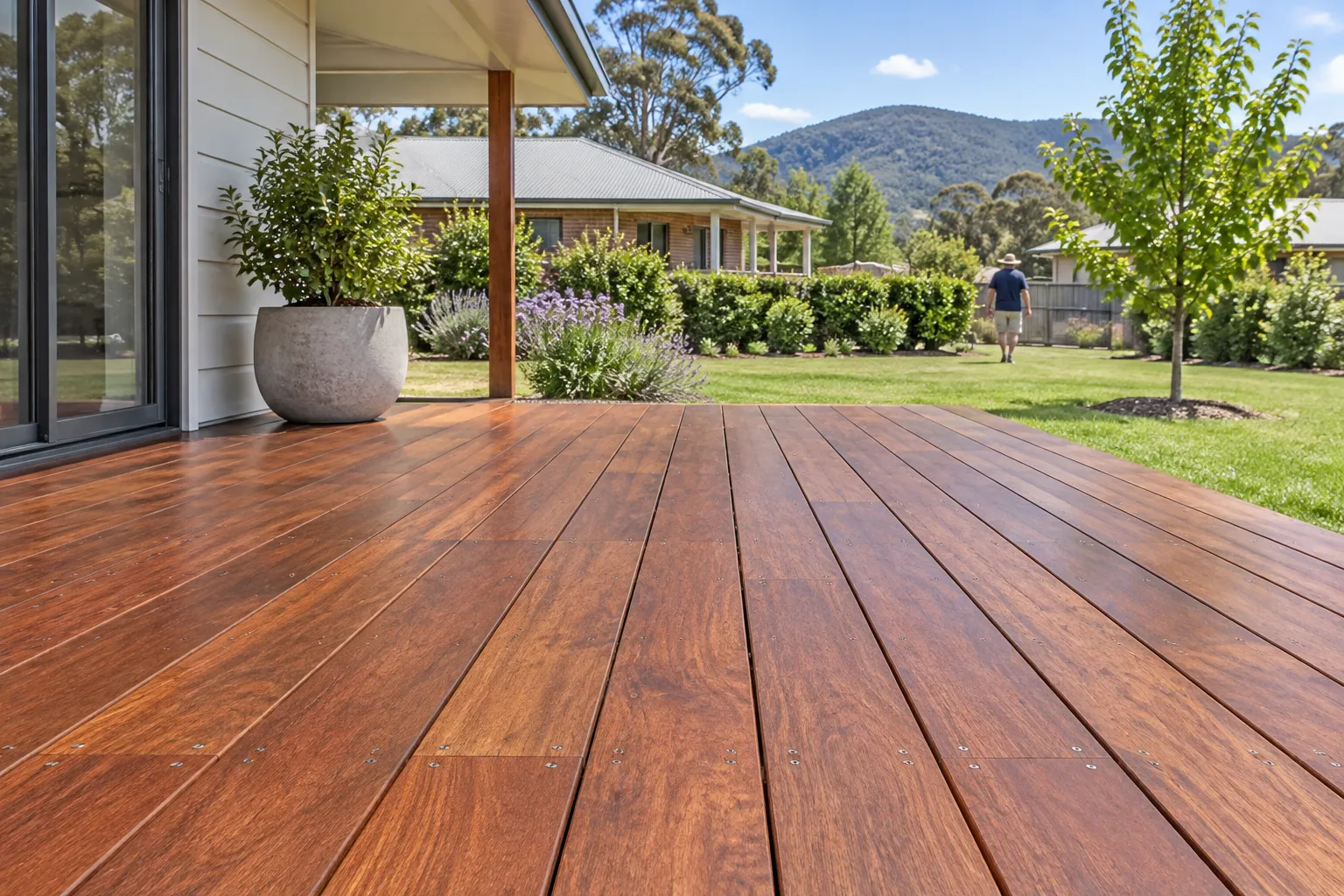
Divide 1,000 by the board width plus the gap to get lineal metres per square metre. At a nominal 140 millimetres with a 5 millimetre gap, that's about 6.9 lineal metres per square metre. Actual dressed boards are a little narrower, so the real figure is slightly higher. Multiply by the deck area and add about 10% for offcuts.
| Deck size | Lineal metres (approx., including 10%) |
|---|---|
| 10 m2 | About 76 m |
| 20 m2 | About 152 m |
| 30 m2 | About 228 m |
| 40 m2 | About 304 m |
What gap should 140 x 19 merbau have?
A gap of a few millimetres, often 3 to 5 millimetres, is common for merbau, depending on how dry the boards are when laid. Drier boards will swell in winter, so they need a slightly wider gap. Wetter boards will shrink in summer, so they can go a little tighter. Too tight, and the gaps close and trap water.
Albury's wet winters and dry summers make this judgement matter more. Builders often use a spacer to keep the gap consistent across the deck.
Does 140 mm merbau cup more than narrower boards?
Wider boards are more prone to cupping, where the edges lift above the centre, because there's more width to move with moisture. 140 millimetre merbau is widely used and performs well on decks with good airflow and drainage. On low decks close to damp ground, many builders prefer 90 millimetre boards, which move less. See merbau decking 90 x 19.
How to keep 140 millimetre boards flat:
- Airflow underneath. Open or vented sides, good clearance.
- Correct gaps. For drainage and movement.
- Even moisture. Let boards acclimatise on site.
- Two screws per joist across the board width.
How do you fix 140 x 19 merbau?
Each board is usually fixed with two screws at every joist, pre-drilled near the ends to stop splitting. Stainless steel decking screws are recommended for merbau, because its tannin reacts with plain steel and leaves black stains. Some decks use hidden clip systems made for hardwood instead of face screws.
What does 140 x 19 merbau cost?
Board prices for 140 by 19 merbau vary between suppliers and change with supply, so get current quotes. Installed, published guides put a merbau deck at about $280 to $550 a square metre including frame and labour. 140 millimetre boards usually cost a little less to lay per square metre than narrower boards. See merbau decking cost.
For all the sizes side by side, see merbau decking dimensions.
Questions people ask
What is 140 x 19 merbau decking?
It's a merbau hardwood decking board with a nominal width of 140 millimetres and a thickness of 19 millimetres, the most common merbau decking size in Australia. The actual dressed size is a little smaller. It's usually laid on joists at 450 millimetre centres and fixed with stainless steel screws.
How many screws per board for 140 mm decking?
Usually two screws per board at each joist, set in from the edges and pre-drilled near the board ends. On a deck with joists at 450 millimetre centres, that's roughly four or five screws per lineal metre of board. Hidden clip systems are an alternative that avoid visible screw heads.
Is 140 x 19 merbau strong enough for stairs?
Many builders prefer thicker 140 by 25 millimetre merbau, or a dedicated stair tread, for stairs, because treads take concentrated loads and span between stringers. 19 millimetre boards can be used on closely spaced stringers. The builder chooses the tread size to suit the stair width and stringer spacing.
Should 140 mm merbau be laid face up or face down?
Merbau decking boards usually have a smooth face and sometimes a reeded or grooved face. Most people lay them smooth face up for a cleaner look. If the boards have a slight natural curve across the width, builders often lay them so they shed water. Ask the supplier if the board has a recommended face.
The rest of our guides start from Border Outdoor Living.
Where these facts come from
Updated