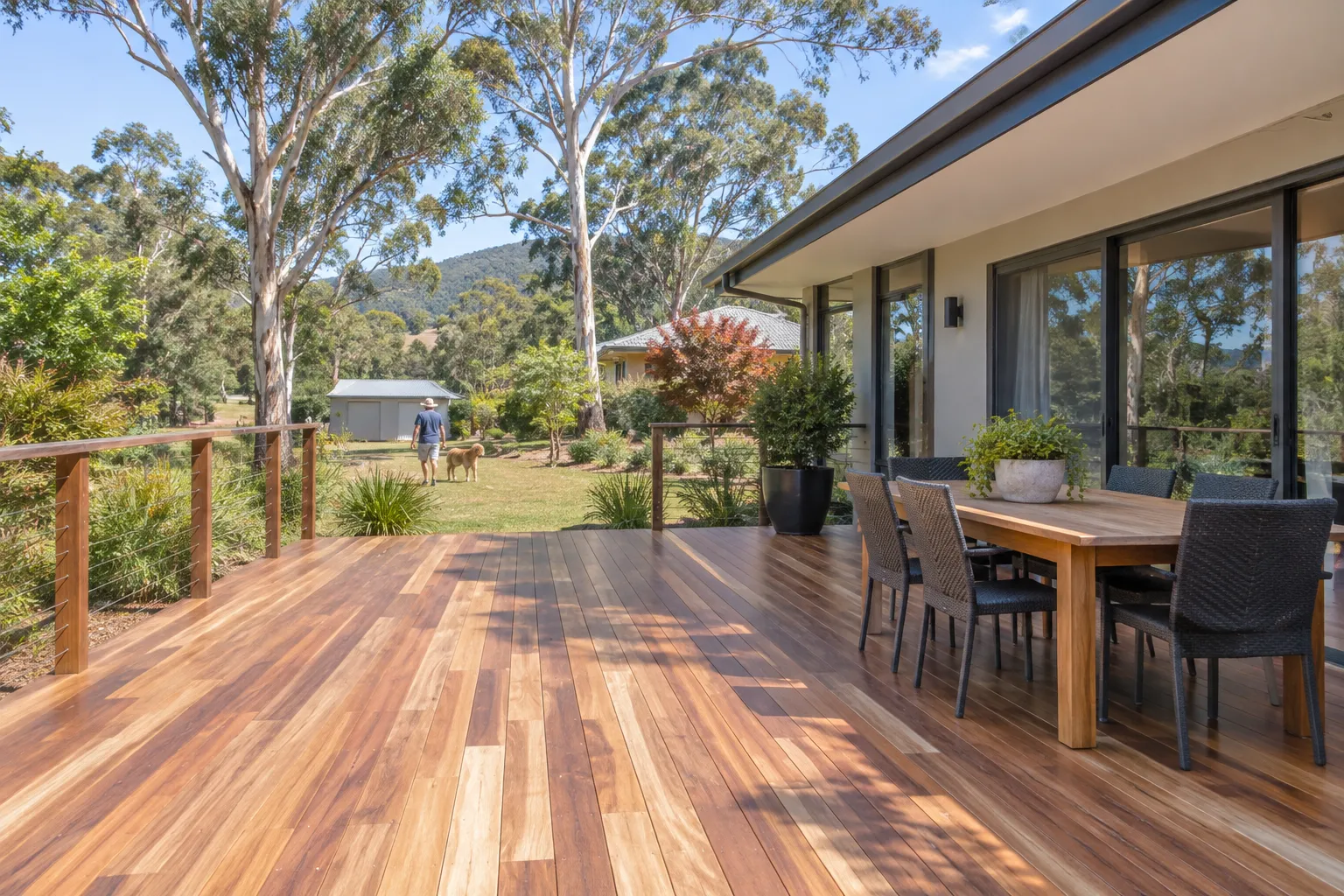
Spotted gum decking is made from a hard, heavy Australian hardwood grown in Queensland and New South Wales. Its grain is wavy and its colour runs from pale grey-brown to deep chocolate, often on the same board. It's rated in the top durability class above ground, and it's listed as a bushfire-resisting timber, which matters in parts of Albury. Installed, a spotted gum deck usually costs about $350 to $600 a square metre. This page covers what the timber is, board sizes, the 3-4-5 rule for setting out, costs and what to ask a builder. If you want a spotted gum deck built, we'll arrange a visit and a local deck builder comes to you with a written quote.
What type of timber is spotted gum?
Spotted gum is a eucalypt hardwood, Corymbia maculata and two close relatives, named for its blotchy bark. Business Queensland lists its density at about 1,010 kilograms per cubic metre and rates the heartwood class 1 above ground, with a life expectancy of more than 40 years, and class 2 in ground. It's very hard, so it resists dents from furniture and foot traffic.
Why people pick it for Albury decks:
- Appearance. The colour varies a lot between boards, from cream to dark brown, which gives a natural, mixed look. Some people love that. Others prefer the even colour of merbau.
- Grain. Wavy, interlocked grain with a slightly greasy feel that takes oil well.
- Toughness. It's one of the hardest common decking timbers, so it suits high traffic and outdoor furniture.
- Local supply. It's grown in Australia, which makes sourcing simpler than imported timbers.
If you're weighing it up against similar timbers, read blackbutt vs spotted gum decking, or see blackbutt decking timber on its own. For merbau, see our page on merbau decking.
Is spotted gum good for decks in bushfire areas?
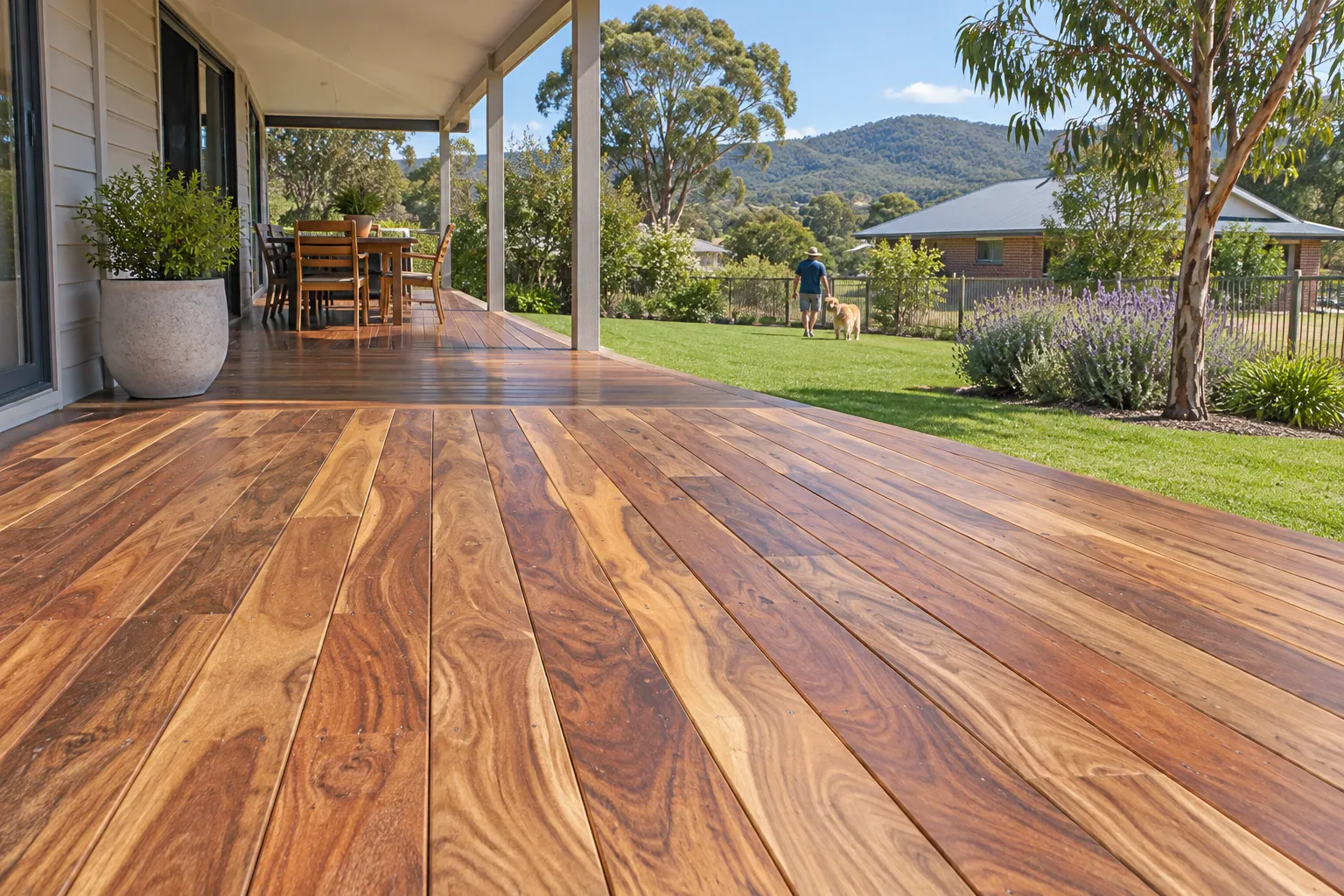
Yes. Spotted gum is one of the timbers listed as bushfire resisting under the Australian bushfire building standard, AS 3959, alongside blackbutt, merbau and a few others. These timbers can be used for decking up to BAL-29. Parts of Thurgoona, Splitters Creek and Jindera are mapped as bush fire prone land, so this can decide which timbers you're allowed to use.
How it works in practice:
- Check your BAL. Your block's bushfire attack level (BAL) comes from a bushfire assessment, or from the council during approval. AlburyCity publishes its bush fire prone land map.
- BAL-12.5 and BAL-19. Most decking timbers can be used, with conditions.
- BAL-29. The decking must be a bushfire-resisting timber, like spotted gum, or a product tested to that level.
- Higher than BAL-29. Timber decking is restricted. A non-combustible deck is usually needed.
The builder will check this as part of the quote. Our pages for Thurgoona and Splitters Creek explain the local bushfire mapping.
What sizes do spotted gum decking boards come in?
Spotted gum decking is usually sold as 86 by 19 millimetres and 135 by 19 millimetres, often called 90 and 140 millimetre boards. The 19 millimetre thickness suits standard 450 millimetre joist spacing. Boards come in random lengths, and premium grades have fewer gum veins and knots. Thicker boards are available for longer spans and stair treads.
| Board size | Also called | Best for |
|---|---|---|
| 86 x 19 mm | 90 mm | Most decks, less movement, classic look |
| 135 x 19 mm | 140 mm | Faster to lay, wider modern look |
| Thicker sections | Stair treads | Steps and wider joist spans |
The narrower 86 millimetre board moves less with Albury's wet winters and dry summers, so it cups less. See spotted gum decking sizes for grades and lengths.
How much does a 40 m2 spotted gum deck cost?
Using published Australian price guides of about $350 to $600 a square metre installed, a 40 square metre spotted gum deck usually costs around $14,000 to $24,000. A low, simple deck on flat ground sits at the bottom of that range. A raised deck with stairs, a balustrade and a sloping block sits at the top or above it.
What moves the price on spotted gum:
- Grade. Select grade boards with few marks cost more than standard or feature grade.
- Height and stairs. More frame, bracing and a balustrade once you're up off the ground.
- The frame. Treated pine is cheaper. Steel framing costs more but won't rot.
- Bushfire rules. Extra detailing or materials on BAL-rated blocks.
- Removing an old deck. Usually priced separately.
These are guide figures. The builder who visits gives you the real price in writing. See spotted gum decking cost for more detail by size.
Is composite cheaper than spotted gum?
Usually not by much upfront. Standard composite boards like Ekodeck often cost about the same as spotted gum per square metre installed, and premium composite costs more. The difference shows over time: spotted gum needs oiling every year or two, while composite doesn't. Spotted gum is harder, cooler underfoot and can be sanded back if it marks.
If you're undecided, our page on composite decking covers the boards, brands and costs.
What is the 3-4-5 rule for decking?
The 3-4-5 rule is a way to check a deck frame is square. Measure 3 units along one side from a corner, and 4 units along the other side. If the diagonal between those two marks is exactly 5 units, the corner is a true right angle. Builders use 300, 400 and 500 millimetres, or 1.2, 1.6 and 2 metres for bigger frames.
Why it matters: a frame that's out of square makes every board run on an angle, and the gap at the edge grows along the deck. Checking both diagonals of the whole frame are equal is the final test.
What problems does spotted gum decking have?
Spotted gum's common problems are colour variation, surface checking (small cracks) if it dries too fast, gum veins, and cupping if boards are laid too tight or without airflow. It's hard on tools and needs pre-drilling. Most of these are avoided with good board selection, the right gaps and regular oiling.
See spotted gum decking problems for each one and how to prevent it. Unoiled spotted gum weathers to a silver grey, which some owners choose on purpose.
Questions people ask
Where is the best place to buy spotted gum decking boards?
Timber merchants and decking suppliers usually carry a wider range of grades and lengths than general hardware stores, and can advise on stock for your job. If a builder is doing the work, they normally supply the boards, which saves you sorting lengths and waste. Ask whichever supplier you use for the grade and where the timber was grown and how it was harvested.
How long does it take to build a spotted gum deck?
A ground-level spotted gum deck of about 20 to 30 square metres usually takes a builder three to six working days once timber is on site. Spotted gum is hard, so pre-drilling every screw adds time compared with pine. Raised decks, stairs, balustrades and approvals add more. The builder gives you a timeframe with the written quote.
What should you ask before hiring someone to build a spotted gum deck?
Ask which grade and board size they'll use, what the frame is and how it's protected, what gap they leave between boards, which screws they use, and whether your block needs a BAL assessment or council approval. In NSW, residential building work over $5,000 must be done by a licensed builder under a written contract.
Does spotted gum need to be oiled?
It doesn't have to be. Unoiled spotted gum still lasts well above ground but turns silver grey and can check more on the surface. Oiling every 12 to 24 months keeps the colour and slows cracking. Most Albury owners oil it. Our guide to deck oiling covers timing and costs.
Is spotted gum better than merbau?
Neither is better for every job. Spotted gum is harder, Australian grown and listed as bushfire resisting. Merbau has a more even red-brown colour but bleeds tannin when new. Both are class 1 above ground. Colour preference and your block's BAL usually decide it.
In this section
- Blackbutt decking timber
Blackbutt decking timber for Albury and Wodonga homes.
- Blackbutt vs spotted gum
Blackbutt vs spotted gum decking for Albury homes: density, durability, colour, bushfire rating, cost and finishes compared, plus ironbark…
- Spotted gum deck cost
What a spotted gum deck costs in Albury and Wodonga in 2026.
- Spotted gum decking problems
Common spotted gum decking problems in Albury: colour variation, surface checking, cupping, gum veins, splitting and greying, with causes…
- Spotted gum decking sizes
Spotted gum decking sizes explained: 86 and 135 mm widths, thickness, lengths, grades and colours, and how many lineal metres you need per…
See Albury deck builder for the other services and what they cost.
Where these facts come from
- Business Queensland, spotted gum timber properties
- Queensland Government timber database, bushfire-resisting timbers
- Agriculture Victoria, spotted gum species guide
- AlburyCity, bush fire prone land
- Published installed decking prices from three Australian cost guides, checked November 2026
Updated