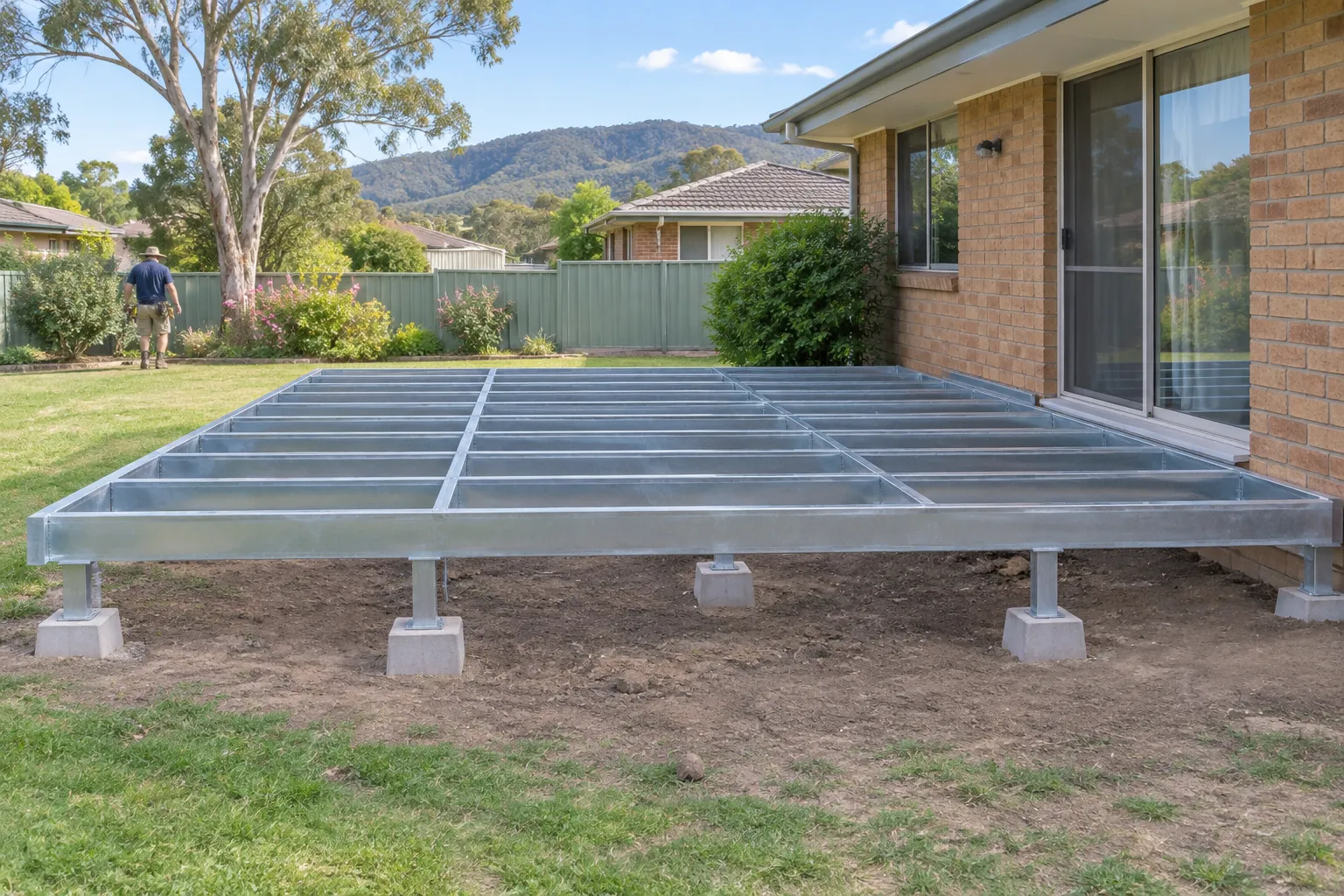
Steel deck framing replaces the timber bearers and joists under a deck with galvanised steel sections, usually a light-gauge system made for decks and floors. Steel doesn't rot, termites don't eat it, it doesn't warp, and it's non-combustible, which helps on bush fire prone land. It can also span further with fewer posts. Published Australian guides put the extra cost of a steel frame over treated pine at roughly $60 to $120 a square metre. This page covers when steel is worth it, joist spacing, spans and what the job involves. If you want a deck built on steel, we'll arrange a visit and a local deck builder comes to you with a written quote.
Is steel deck framing worth it?
Steel framing is usually worth it for decks that sit low to the ground, decks on bush fire prone land, decks in termite-prone spots, raised decks with long spans, and anyone planning to keep the deck for decades. For a small, high, well-ventilated deck on a tight budget, a well-built treated pine frame can still be a sensible choice.
| Situation | Steel frame | Treated pine frame |
|---|---|---|
| Low deck, under 400 mm clearance | Strong choice | Needs H4 and good airflow |
| Bush fire prone land | Non-combustible frame | Restricted at higher BAL levels |
| Long spans, fewer posts | Spans further | Needs deeper timber or more posts |
| Composite boards | Stays flat and true | Can twist and show through boards |
| Tight budget, small deck | Costs more | Cheaper upfront |
For a closer look, read steel deck framing vs wood and how long a deck frame lasts.
How far apart do you put joists on a deck?
Joists are usually spaced at 450 millimetres apart for 19 millimetre hardwood boards, and often closer, around 350 to 400 millimetres, for thinner or composite boards. The board manufacturer sets the maximum spacing, especially for composite, where wider spacing can void the warranty. Diagonal boards need closer joists, because each board spans further between supports.
Guidelines that apply on most Albury decks:
- Hardwood, 19 mm. 450 mm centres is common.
- Treated pine, 22 mm. Often 450 mm, check the board supplier.
- Composite. Follow the brand's table: many sit between 300 and 450 mm.
- Diagonal or herringbone layouts. Closer joists and extra blocking.
How far can a joist span on a deck?
It depends on the material, the section size, the grade, the spacing and whether the joist runs over one span or several. Steel systems publish their own span tables, and steel generally spans further than timber of a similar depth. For timber, a 140 by 45 millimetre joist spans further in a higher grade and at closer spacing. There's no single figure: the frame is sized from the tables for your deck.
This is where steel often saves money elsewhere: longer spans mean fewer bearers, fewer posts and fewer footings, which helps on sloping blocks.
What does building a deck on a steel frame involve?
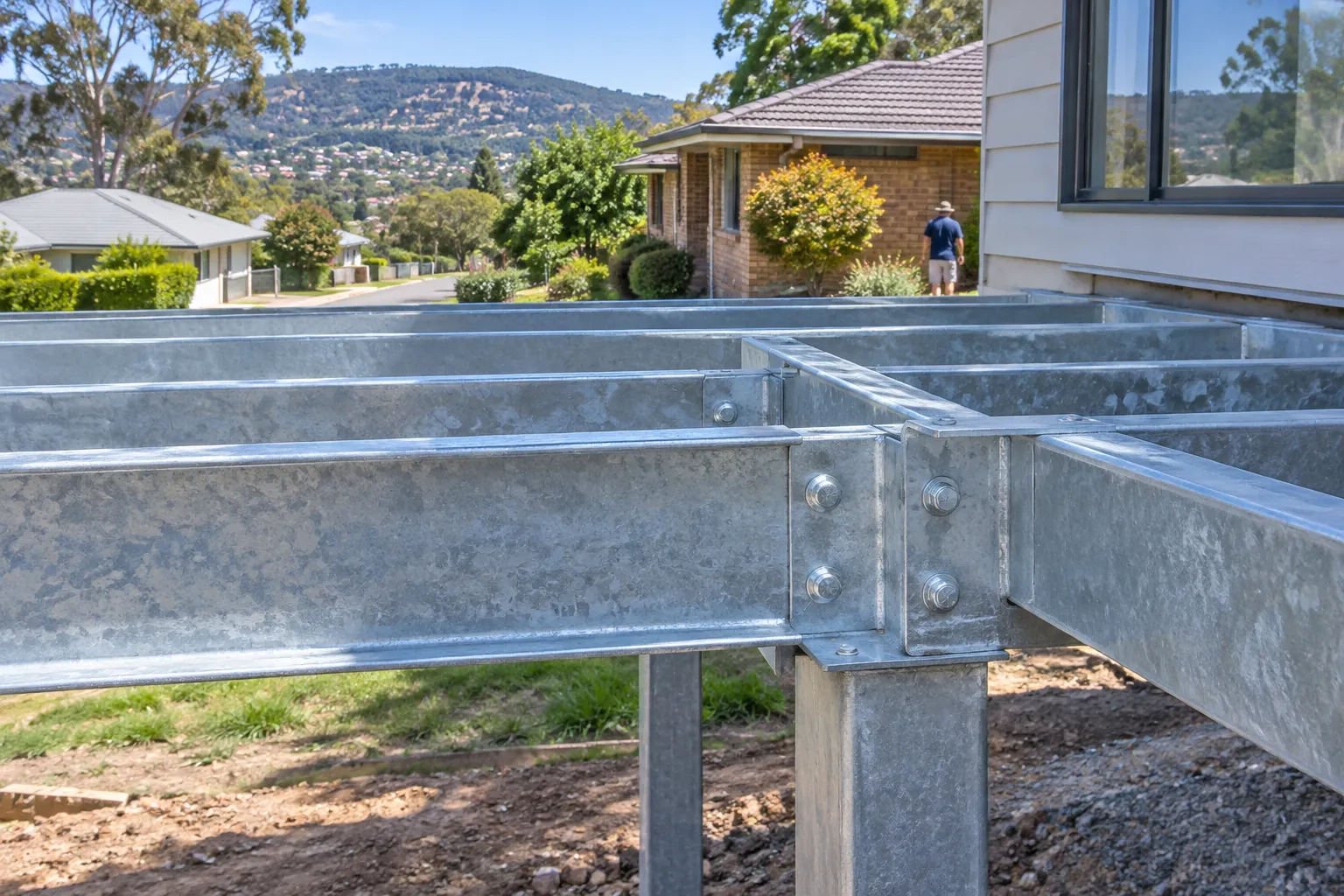
A steel-framed deck goes up much like a timber one. Footings and posts first, then steel bearers and joists bolted or screwed together, levelled and braced, then the boards fixed on top with screws or clips made for steel. Many systems are cut to length at the factory from your plan, which speeds up the build but means measuring carefully first.
The usual steps:
- Site visit and plan. Levels, footings, heights and the board you've chosen.
- Ordering. The frame is often made to length for your deck.
- Footings and posts. Concrete footings with steel posts or brackets.
- Frame. Bearers and joists fixed together, squared and levelled.
- Boards. Fixed with screws or clips rated for steel, then trims and steps.
For very low decks, adjustable pedestals or deck blocks are sometimes used instead of dug footings. If you're sticking with timber, see decking frame timber.
Does a steel frame help with bushfire rules in Albury?
Yes, it often does. Steel is non-combustible, and the Australian Steel Institute notes that steel framing gives more resilience on higher bushfire attack levels. Parts of Thurgoona, Splitters Creek and Jindera are mapped as bush fire prone land. On those blocks, a steel frame with a bushfire-resisting or non-combustible board can be the simplest way to meet the rules.
Your block's bushfire attack level (BAL) decides what's needed. The builder checks it as part of the quote, and the council confirms it during any approval.
What does steel deck framing cost?
Published Australian decking guides put the extra cost of a steel or aluminium sub-frame at roughly $60 to $120 a square metre over a treated pine frame. On a 25 square metre deck, that's around $1,500 to $3,000 more. Fewer posts and footings on long spans can offset some of it, and the frame should outlast a timber one.
Our steel deck framing cost guide breaks it down by deck size. The builder who visits gives you the real price in writing.
Questions people ask
How long does it take to build a steel deck frame?
A steel frame for a typical 20 to 30 square metre deck often takes one to three days to stand and level once the footings are set, then the boards go on. Factory-cut systems can be quicker than cutting timber on site. Ordering the frame adds a wait before work starts. The builder gives you a timeframe with the written quote.
What should you ask before hiring someone for a steel-framed deck?
Ask which steel system they use and its coating, how it's fixed to the footings, what joist spacing suits your boards, whether the frame is cut to length, and how they'll protect cut ends from rust. Ask about BAL and council approval. In NSW, residential building work over $5,000 must be done by a licensed builder under a written contract.
Do you need to be home while a steel deck frame goes in?
Usually only at the start, to confirm the layout, heights and step positions, and at the end, to walk through the finished deck. In between, the builder needs access to the site and power. If the frame is delivered on a separate day, someone may need to be there to accept it, or agree where it can be left.
Does a steel deck frame rust?
Galvanised steel deck framing is coated with zinc that protects it, and well-made systems last a long time above ground. Cut ends and scratches should be touched up with a zinc-rich paint. Frames sitting in pooled water, buried in soil or close to the coast corrode faster. Good drainage and airflow under the deck help steel and timber alike.
Can you put timber boards on a steel frame?
Yes. Timber and composite boards both go on steel frames, fixed with screws or clips made for steel. Hardwoods like spotted gum and merbau are common on steel frames, and so is composite. The frame stays straight, which helps boards sit flat. See composite decking or spotted gum decking.
In this section
- Deck blocks
Deck blocks and adjustable pedestals for low decks: how they work, which decks suit them, Albury's clay soils, levelling, limits and…
- Decking frame timber
Decking frame timber explained: treated pine grades and hazard classes, joist and bearer sizes, how span tables work, hardwood joists, and…
- How long a deck frame lasts
How long deck frames last: treated pine hazard classes, hardwood and galvanised steel frames, what makes frames fail early in Albury, and…
- Steel deck framing cost
What steel deck framing costs in Albury and Wodonga.
- Steel vs timber framing
Steel deck framing vs treated pine frames compared for Albury decks: cost, lifespan, rot and termites, spans, bushfire, straightness for…
See deck builder albury for the other services and what they cost.
Where these facts come from
- Australian Steel Institute and NASH, bushfire design and detail
- WoodSolutions, preservative treatments and use classes
- AlburyCity, bush fire prone land
- Published decking prices from three Australian cost guides, checked November 2026
Updated