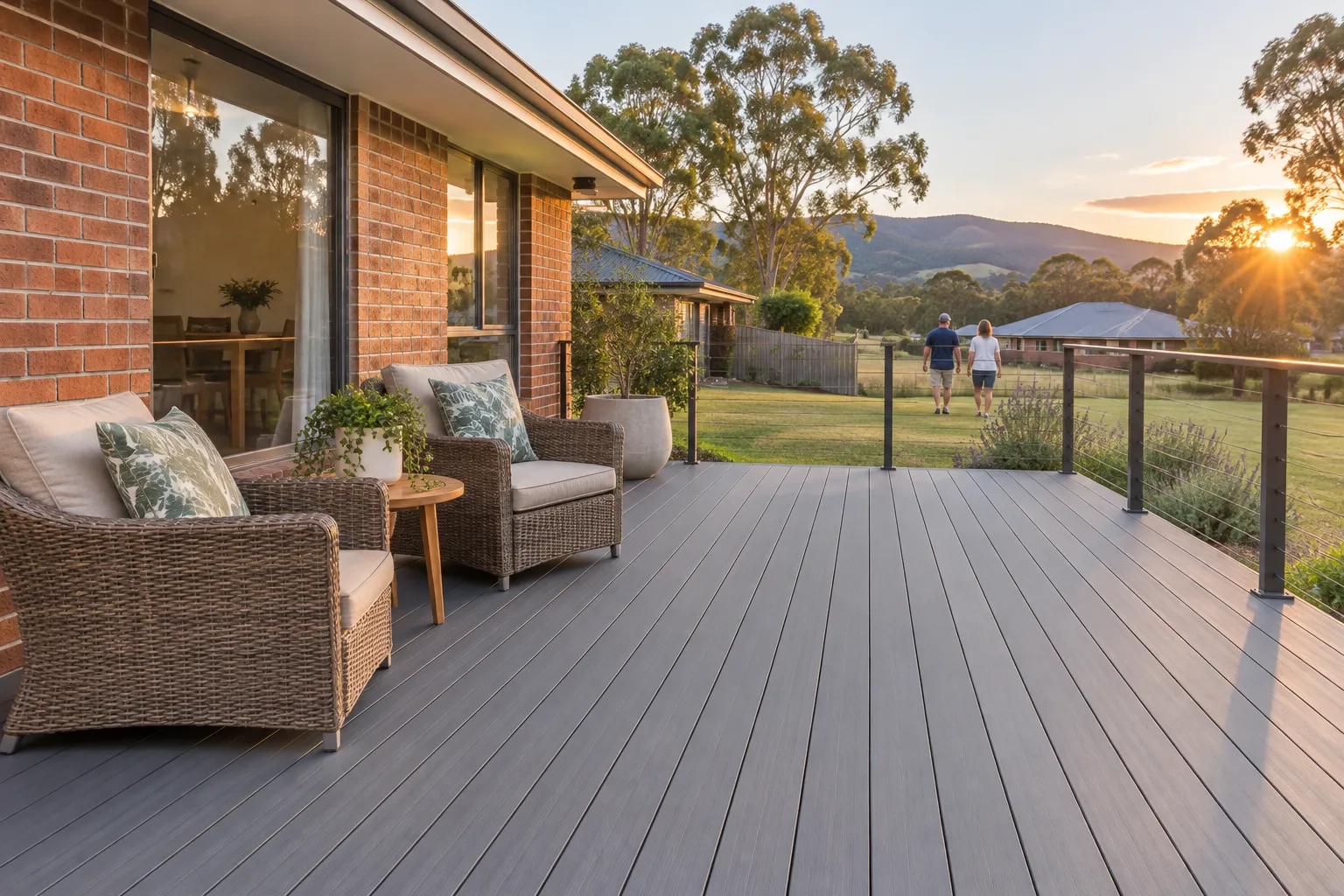
Composite decking is a board made from wood fibre and plastic, shaped and coloured to look like timber. It doesn't need oiling, it won't rot, and termites don't eat it. Installed on a standard timber or steel frame, a composite deck in Albury usually costs about $280 to $700 a square metre, with most jobs near $480. This page covers what the boards are, how they compare with merbau and spotted gum, what moves the price, and what to ask before you sign. If you want a deck built, we'll arrange a visit and a local deck builder comes to you with a written quote before any work starts.
What is composite decking made of?
Composite decking is a mix of wood fibre or sawdust and plastic, usually polyethylene, heated and pressed into boards. Trex says its Australian boards are made from 95% recycled material, including reclaimed wood and plastic film. The plastic keeps water and insects out. The wood gives the board weight and a grain look. Many brands add a hard outer shell, called a cap.
There are two main kinds of board you'll see in Albury quotes:
- Uncapped boards. The same material all the way through. Cheaper, but they mark and fade more easily. Older composite decks with mould spots and stains are usually this kind.
- Capped boards. A tough polymer layer wraps the core. They resist stains, scratches and fading much better, and most premium ranges are capped now. Our guide to capped composite decking explains the difference in detail.
You'll also see the term wood plastic composite decking, or WPC. It's the same family of product. PVC and aluminium boards are different materials again, with no wood in them.
Can you buy Trex and other brands in Australia?
Yes. Trex has an Australian website and sells through local stockists, and several other brands are widely available on the Border. The names you'll hear most in quotes are Trex, ModWood (made in Australia), Ekodeck, Millboard and Eva-Last. They differ in core material, cap, colour range and warranty length, so compare the product sheets, not only the price per board.
A quick guide to what each is known for:
| Brand | What sets it apart | Our guide |
|---|---|---|
| Trex | US maker, high recycled content, capped ranges | Trex composite decking |
| ModWood | Australian made, wood and recycled plastic | ModWood composite decking |
| Ekodeck | Wide colour range, popular for pools | Ekodeck composite decking |
| Millboard | Moulded from real timber, no plastic look | Millboard composite decking |
| Eva-Last | Capped boards, several core types | Eva-Last composite decking |
If you're still choosing, our comparison of the best composite decking in Australia sets the main ranges side by side. A builder can work with whichever brand you pick, and many will suggest one they install often.
What's the difference between composite decking and timber decking?
Timber decking is a natural board, like merbau, spotted gum or treated pine, that you oil or stain to protect it. Composite is a manufactured board that keeps its colour without oil. Timber is usually cheaper at the low end and feels natural underfoot. Composite costs more for the boards but saves you an oiling every year or two for the life of the deck.
The differences that matter most around Albury and Wodonga:
- Heat. Albury summers often run well over 30 degrees. Dark composite boards can get very hot in full sun, more than pale timber. If the deck faces west with no shade, choose a light colour or plan a pergola over it.
- Frost and wet winters. Composite doesn't split or cup the way timber can after years of wet and dry. It can still get slippery with algae in shady spots, so it needs a wash.
- Termites. The boards are termite resistant, but the frame underneath usually isn't. Most composite decks here sit on treated pine or steel deck framing, and the frame is what you protect.
- Bushfire zones. In bushfire prone areas like parts of Thurgoona and Splitters Creek, the board must suit the site's bushfire attack level (BAL). Check the manufacturer's BAL test results for the exact product.
For a deeper side by side, read hardwood decking vs composite.
What is the average cost of a composite deck in Albury?
Published Australian price guides put an installed composite deck at about $280 to $700 a square metre, with a typical figure around $480. Premium capped boards sit toward the top of that range, often $450 to $900. So a 20 square metre deck at ground level usually lands somewhere near $6,000 to $14,000, before any steps, balustrades or a roof.
What moves the price on a composite deck:
- The board range. Uncapped boards cost least. Capped and premium ranges cost more.
- The frame. Treated pine is cheapest. Steel or aluminium frames add roughly $60 to $120 a square metre in published guides, but last longer.
- Height. A deck more than about 600 millimetres off the ground needs more frame, bracing and often a balustrade.
- Access and ground. Sloping blocks, rock and tight side access all add labour.
- Removing an old deck. Demolition and disposal is usually extra, often $20 to $55 a square metre.
These are guide figures from published price lists. The builder who visits gives you the real price for your site, in writing. Our composite decking cost page breaks the numbers down by deck size.
Is Ekodeck cheaper than timber?
Usually not upfront. Ekodeck and most other composite boards cost more to buy than treated pine and about the same as or a little more than hardwoods like merbau or spotted gum. Where composite wins is over time: you skip the deck oil, the sanding and the stain that timber needs every year or two.
A simple way to compare: price a timber deck, then add the cost of oiling it every 12 to 24 months for 15 years. For many people that gap closes, especially on a large deck or one that gets full sun. If you like the Ekodeck look, the Ekodeck colours guide shows the range.
How is composite decking installed?
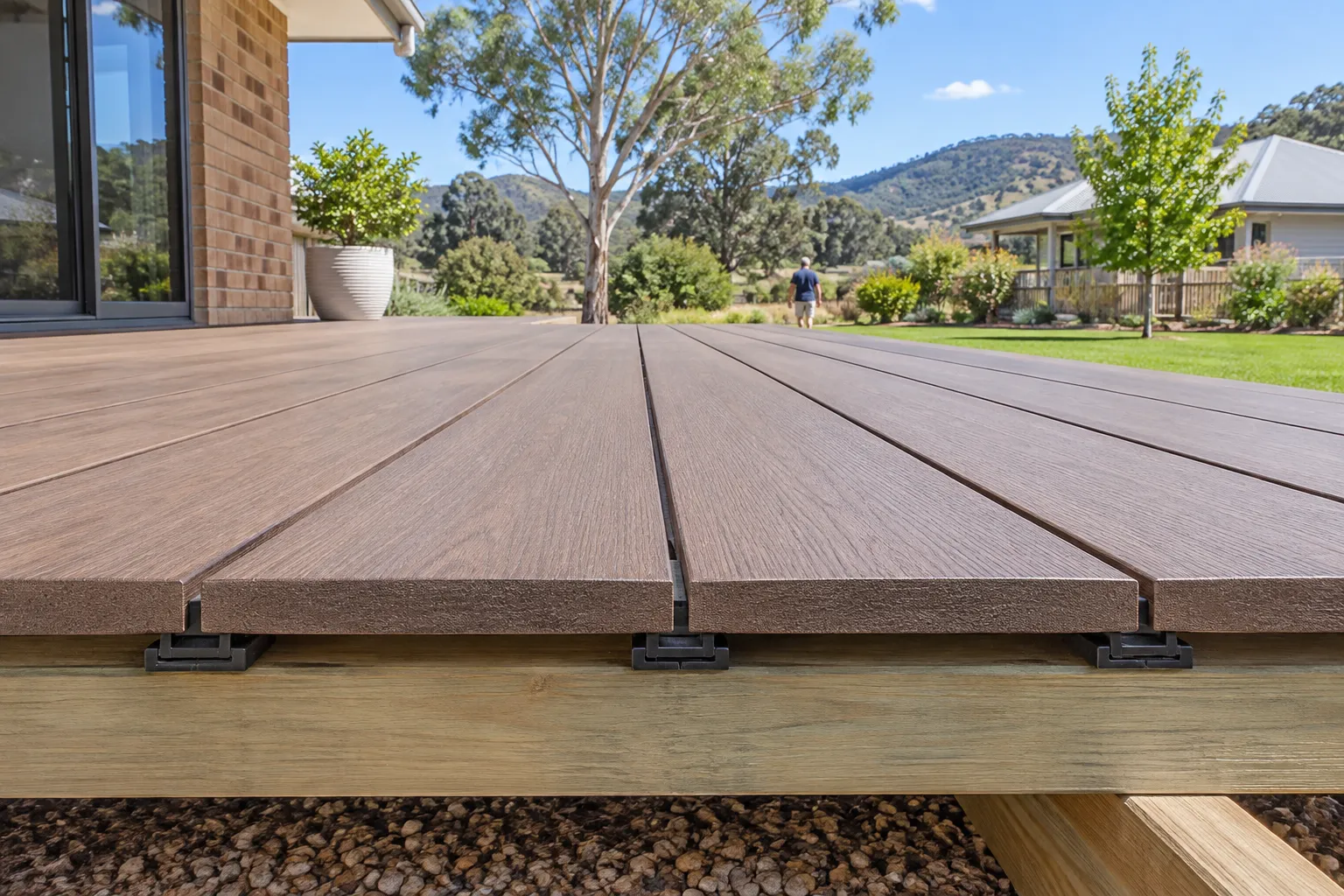
Composite boards go on a frame of bearers and joists, like timber, but they're fixed with hidden clips rather than face screws, and they need set gaps for expansion. Joists are usually closer together than for hardwood, and the boards need airflow underneath. Fitting them to the maker's instructions keeps the warranty valid.
A typical job runs like this:
- A builder visits, measures and checks the ground, the drainage and any approval questions.
- You get a written quote that names the board range, the frame and the finish.
- Footings and the frame go in, levelled and spaced to suit the board.
- Boards are clipped down with the right gaps, then fascia, steps and trims.
If you're weighing up doing it yourself, our guide to composite decking installation covers what the job really takes. In NSW, residential building work over $5,000 must be done by a licensed builder under a written contract. In Wodonga, Victorian permit rules apply, and the VBA says most decks need a building permit.
How do you look after a composite deck?
Composite needs far less care than timber, but not none. Sweep it often, wash it a few times a year with warm soapy water and a soft brush, and clear leaves from the gaps so water can drain. Avoid metal shovels on the surface and strong solvents. Mould usually shows up in shady, damp corners first.
Our guide to cleaning composite decking covers stains, grease and mould step by step. Most capped boards carry long fade and stain warranties. How long one actually lasts depends on the product and the frame: see how long a composite deck lasts.
Questions people ask
Is it cheaper to build a wood deck or a composite deck?
A treated pine deck is usually the cheapest to build. Hardwood and composite cost about the same per square metre installed, with premium composite at the top. Over 10 to 20 years, composite can work out cheaper because you don't pay for oiling or staining. The longer you plan to stay, the better composite looks.
What is the downside of composite decking?
Composite boards cost more upfront than treated pine, dark colours get hot in full sun, and cheap uncapped boards can fade, stain and grow mould. They can't be sanded back like timber. Scratches stay. The frame below is usually timber, so it still needs to be built and protected properly.
Can you build a deck for $5,000?
Sometimes, if it's small and at ground level. Using the published range of $280 to $700 a square metre, $5,000 buys about 7 to 15 square metres of composite, or more in treated pine. Steps, height, balustrades and a sloping block all reduce what that budget covers. A written quote for your site tells you for sure.
What is the downside of Trex decking?
Trex boards cost more than many other composites, and the darker colours can get hot in a hot Albury summer. Like any composite, they can't be sanded or refinished if they scratch. The frame is still usually timber, so it needs good airflow and ground clearance. Check the current Trex range and warranty for the exact board.
Which is better, Trex or PVC decking?
Trex is a wood and plastic composite. PVC boards are all plastic. PVC is usually lighter and handles wet areas very well, while composite feels more like timber underfoot and is more common in Australia. The better choice depends on heat, budget and where the deck sits. A builder can show you samples of both.
What colours does composite decking come in?
Most ranges come in browns, greys and charcoal, with a few pale sand and driftwood shades. Grey and charcoal are popular with modern houses, while warm browns suit brick and weatherboard. On a sunny west-facing deck in Albury, a lighter colour stays cooler. See ModWood decking colours for one range.
In this section
- Best composite decking
How to choose the best composite decking for an Albury or Wodonga home.
- Capped composite decking
Capped composite decking explained for Albury and Wodonga homes.
- Cleaning composite decking
How to clean composite decking: routine washing, mould and algae, grease and food stains, rust marks and leaf stains, and what not to use…
- Composite decking cost
Composite decking costs in Albury and Wodonga for 2026.
- Composite decking installation
How composite decking is laid, step by step: frame, joist spacing, clips, gaps and ventilation.
- Ekodeck colours
Ekodeck colours by range, and how to choose a composite decking colour for an Albury home: heat, dirt, house style, sun direction and…
- Ekodeck composite decking
Ekodeck composite decking for Albury and Wodonga homes.
- Eva-Last composite decking
Eva-Last composite decking for Albury and Wodonga homes.
- Hardwood decking vs composite
Hardwood decking vs composite for Albury and Wodonga homes.
- How long composite lasts
How long a composite deck lasts in Albury's climate.
- Millboard composite decking
Millboard decking for Albury and Wodonga homes.
- Modwood composite decking
ModWood composite decking for Albury and Wodonga homes.
- Modwood decking colours
How to choose a ModWood decking colour for an Albury or Wodonga home: heat, sun direction, dirt, house style, mixing colours and testing…
- Trex composite decking
Trex composite decking for Albury and Wodonga homes.
- Wood plastic composite decking
Wood plastic composite (WPC) decking explained.
See deck builder in Albury for the other services and what they cost.
Where these facts come from
- Trex Australia, sustainable decking products
- NSW Planning Portal, exempt development for balconies, decks and patios
- NSW Government, checking your contractor is qualified
- Victorian Building Authority, landscaping and outdoor structures
- Published installed prices from four Australian decking cost guides, checked November 2026
Updated