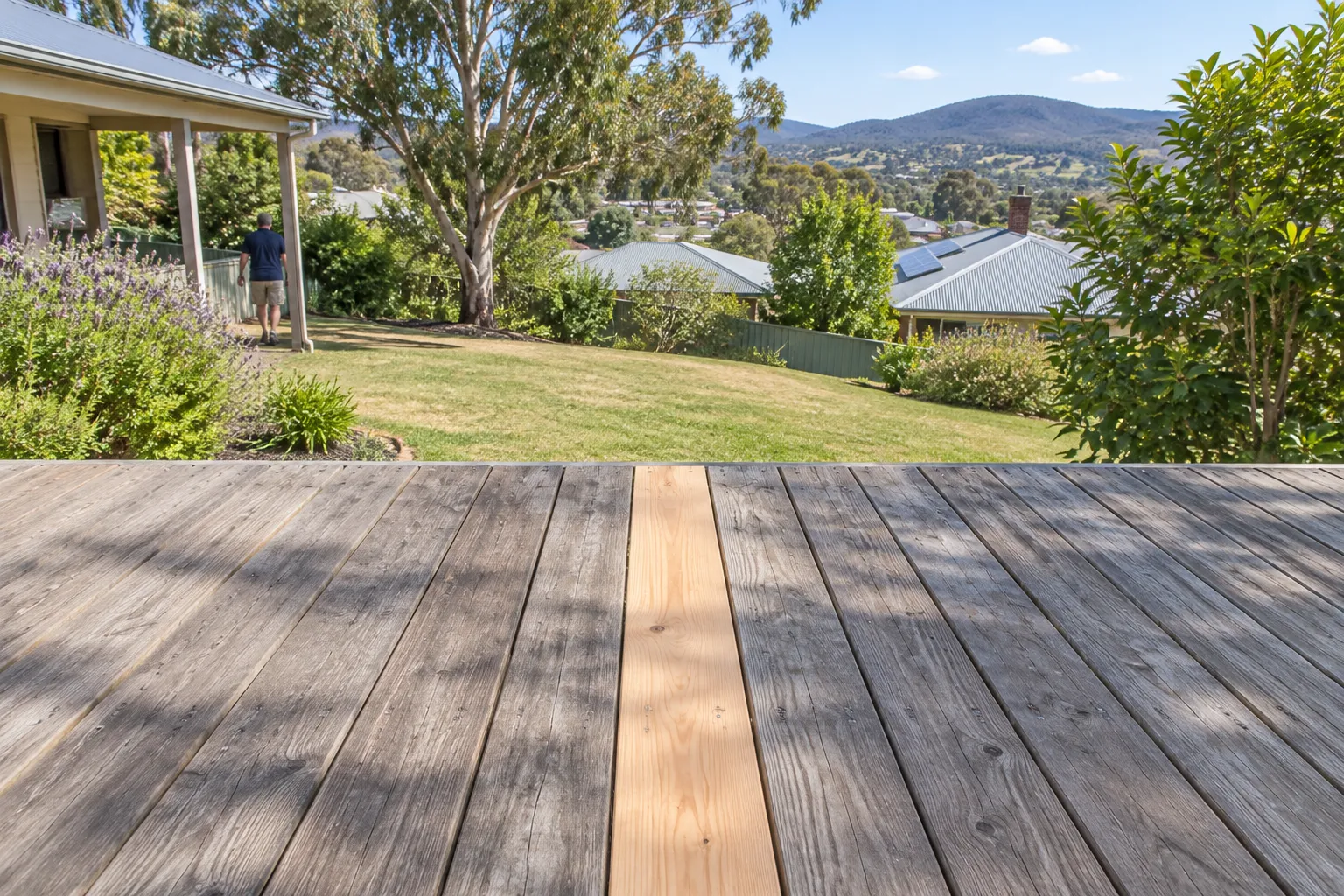
Repair deck boards when the problem is limited to a few boards on a sound frame: split ends, a handful of soft or cupped boards, popped nails or loose screws. Replace boards when they're widely rotten, badly split or cupped across much of the deck. Replace the whole deck when the frame or footings are failing. Checking underneath with a torch and a screwdriver is the first step. For costs and how a builder can help, see our Albury deck builder home page.
How do you tell if a deck board needs replacing?
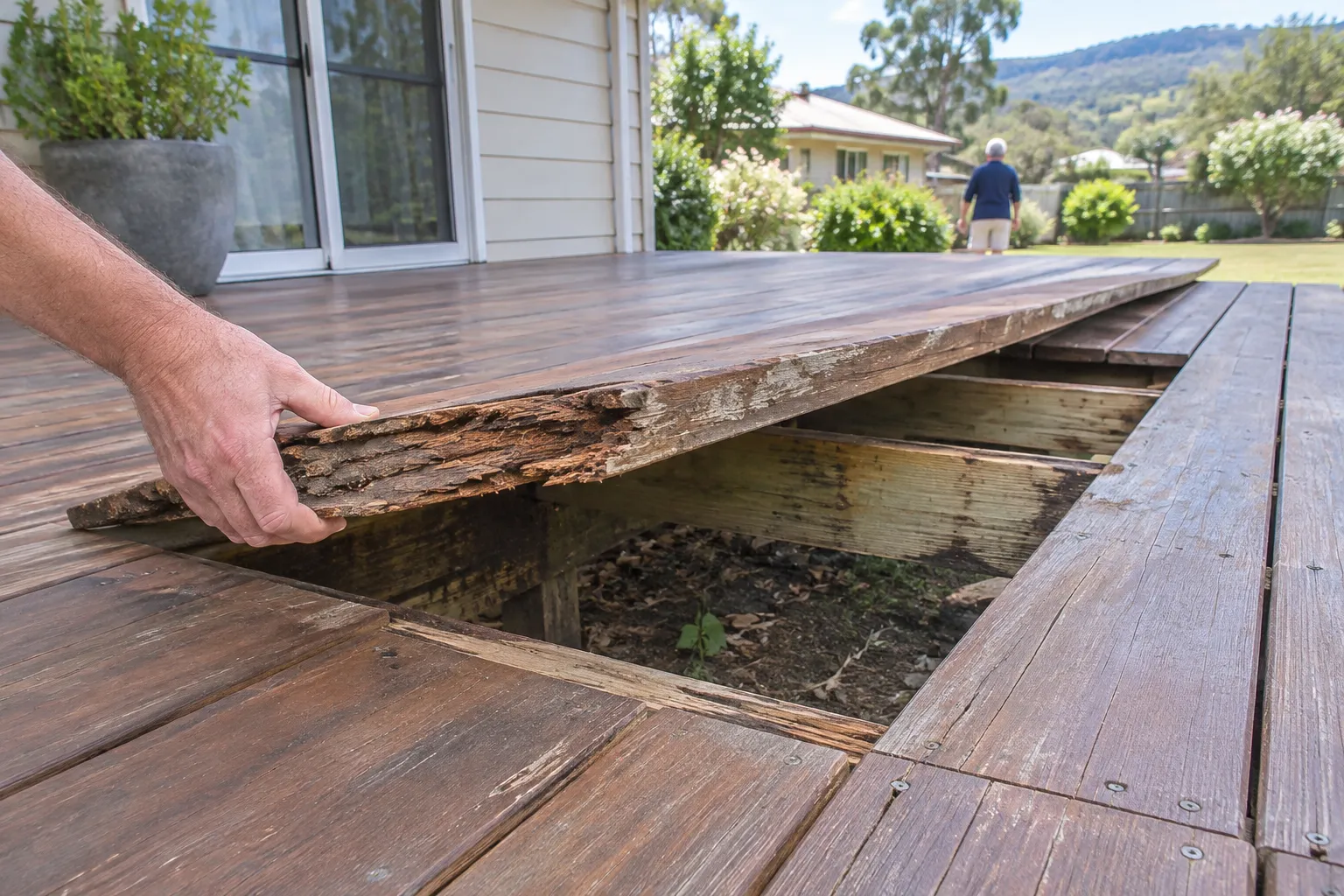
Press a screwdriver into the board, especially near the ends and where it crosses joists. Sound timber resists. If the screwdriver sinks in easily, the board is rotting and should be replaced. Deep splits that go right through, boards that have cupped badly, and boards that flex a lot underfoot are also candidates for replacement.
| Board problem | Usually |
|---|---|
| Grey, rough surface | Restore: clean, sand, oil |
| Surface checks (fine cracks) | Restore |
| Popped nails or loose screws | Repair: refix with screws |
| Split end | Repair: trim and refix, or replace |
| Soft or spongy board | Replace |
| Badly cupped board | Replace, and fix the cause |
Why check the frame before the boards?
Boards rest on joists, and a board that's rotten often sits on a joist that's rotting too. If the frame is sound, replacing boards is a simple job. If joists, bearers or posts are soft or the footings have moved, new boards won't fix the deck. Check underneath first, especially near the ground and where water collects.
See how long a deck frame lasts and signs of termites in a deck.
How do you replace a damaged deck board?
Remove the fixings and lift the board out, or cut it into sections to remove it. Check the joists underneath. Cut a new board to length so each end lands on a joist, seal the cut ends if it's treated pine, and fix it with two screws per joist, pre-drilling hardwood near the ends. Match the gap to the boards around it.
The steps:
- Remove fixings or cut the board out.
- Check the joists underneath for rot.
- Cut the new board to land on joists.
- Seal cut ends of treated pine.
- Fix with stainless or galvanised screws.
- Finish with oil to blend it in.
Will new deck boards match the old ones?
Not straight away. Old boards have weathered and darkened or greyed, so new boards stand out at first. Sanding the whole deck and applying a tinted oil helps them blend in, and over a few months of sun the difference fades. Finding the same species and width is important: see merbau decking dimensions or treated pine decking sizes.
When should you replace the whole deck?
Replace the whole deck when the frame is widely rotten or termite damaged, the footings have sunk or tilted, the deck bounces or leans, most boards are bad, or the deck doesn't meet current rules (for example, a missing balustrade on a high deck) and fixing it would cost close to a new deck. Otherwise, repairing and restoring usually costs much less.
Is it cheaper to repair or replace a deck?
Repairing is almost always cheaper when the frame is sound. Board replacement is usually priced by the board or by the hour, and a sand and refinish costs about $35 to $70 a square metre in published NSW guides. Replacing a whole deck costs the demolition, about $20 to $55 a square metre, plus a new deck at about $180 to $700 a square metre.
See replacing deck cost and timber decking restoration.
Should you re-board the deck instead?
If many boards are bad but the frame is sound, re-boarding the whole deck on the existing frame gives an even, new surface for less than a full rebuild. It's also a good time to switch to composite, as long as the joist spacing suits the composite brand, which often needs closer joists than older timber decks have.
See composite decking installation.
Questions people ask
Should I repair or replace my deck?
Repair if the frame and footings are sound and the problems are limited to some boards, fixings or the finish. Replace if the frame is rotten, the footings have failed, or most boards are bad. A builder can check underneath and quote both options, so you can compare the cost of fixing with the cost of starting again.
How do you know if deck joists are rotten?
Push a screwdriver into the joists, especially near the ground, at the ends and where boards are fixed. Sound timber resists. Rotten timber is soft, spongy or crumbly, and may be darker or have fungus growing on it. Check from underneath with a torch. Soft joists need replacing to keep the deck safe.
Can you replace just one deck board?
Yes. Replacing a single damaged board is a straightforward job, as long as the joists underneath are sound. The new board should be the same species and width, cut so each end lands on a joist, and fixed to match. It will look different at first and blend in as it weathers or after the deck is re-oiled.
Can you flip deck boards instead of replacing them?
Sometimes. If a board is weathered or cupped on top but sound, it can be lifted and turned over, which shows the fresher underside. It works only if the board is still sound and the underside isn't damaged or stained. Old fixing holes need to land on joists again, or be filled.
Where these facts come from
- WoodSolutions, preservative treatments and use classes
- Published decking, demolition and restoration prices from Australian cost guides, checked November 2026
Updated